

Which baby pillows are useful and safe? An overview

Many parents are unsure whether their baby needs a pillow. There are special pillows for flat head (plagiocephaly), positioning and nursing pillows, wedge pillows for reflux, or regular flat pillows. However, generally speaking, a baby's bed should be as sparse as possible. Experts have been emphasizing for years that babies should sleep on a firm, flat surface without soft objects in the first few months. Therefore, pillows, thick blankets, or bumper pads do not belong in the sleeping environment. Below, we introduce the different types of pillows and their uses – with a focus on risks and recommendations from pediatricians, midwives, and health experts.
Overview of Baby Pillow Types
- Head-Shaping Pillows (Plagiocephaly Pillows): These pillows usually have a hollow for the back of the head and are designed to reduce pressure on the skull when lying on the back. They are often found in stores as "baby head pillows for flat head." In practice, however, parents are advised to change positioning and do targeted exercises (e.g., tummy time and changing sleeping positions) rather than relying on a pillow. The effectiveness of these special pillows is not scientifically proven. Studies show no significant advantage; flat head syndrome usually resolves on its own. Furthermore, experts emphasize that the baby should continue to sleep on a firm surface and that pillows can even be dangerous here (see below). A common recommendation is to only use such a pillow after consulting with a pediatrician or physical therapist and to observe the baby closely.
- Positioning and Nursing Pillows: Positioning pillows (also called side-lying or neck pillows) are often U-shaped cushions designed to support the baby when lying down, for example, in a side-lying position or while breastfeeding. They can help support the head or gently hold the baby in place. Important: These pillows are only suitable for short periods when supervised and awake – they are not suitable for sleeping in bed. There is a risk of suffocation, especially with unintentional rolling. Specialists emphasize that babies should always sleep on their back if possible and that unsupervised side or tummy sleeping should be avoided. A positioning pillow can at most serve to support the chosen position during diaper changes or breastfeeding.
- Wedge and Anti-Reflux Pillows: These types of pillows are usually wedge-shaped or slightly inclined and elevate the baby's upper body. They are often recommended for babies with infant reflux (spitting up) to prevent stomach acid from flowing back. Such pillows are also offered for respiratory problems (e.g., a cold). However, great caution is advised from a medical perspective: The American Academy of Pediatrics (AAP) explicitly advises that reflux babies sleep flat on a flat, firm surface and avoid products that elevate the head. In Germany, too, experts recommend treating reflux with other methods (elevated feeding position during breastfeeding/bottle feeding, possibly medication) instead of elevating the baby with pillows at night. Tilting by more than approx. 10° is also considered unsafe. When a baby is lying on a wedge pillow, there is a risk of slipping; the baby can roll off the pillow and end up in a tummy-down position. Conclusion: Wedge pillows/anti-reflux pillows should only be used under medical guidance and never in a fixed bed.
- Classic Baby Pillow (Small Flat Pillow): Soft, flat baby pillows – often with cute designs – are popular among parents. However, pediatric sleep experts advise completely avoiding a pillow during the first year of life. Only from an age when the child can move safely on their own (from approx. 12–24 months) can a very flat, firm pillow be used. Even then, it should be as low as possible so that the child does not sink into it. Until then, the baby's head is best placed directly on the mattress or in a sleeping bag without cushioning – this protects the neck and back.
Medical Recommendations
Pediatricians, midwives, and healthcare institutions recommend a simplified sleeping environment. The Stiftung Kindergesundheit (Foundation for Children's Health) advises: "In the first twelve months of life, your baby needs no pillow at all and it should be avoided for safety reasons." A flat pillow (only high enough that the head does not sink in) may follow if necessary. The DGKJ (German Society for Pediatrics and Adolescent Medicine) also warns against having objects in the baby's bed that could cover the mouth and nose – this includes large pillows, bumper pads, or soft mattresses. The AAP safety guidelines state: "Babies under one year of age are safest when sleeping on their back on a firm, flat surface, without pillows, blankets, bumper pads, or other soft bedding." In all cases: sleeping bag instead of blanket (no loose cloths), back sleeping, room temperature approx. 16–18°C. Reflux and back problems: Even according to the AAP, even babies at risk of reflux should not sleep with their head elevated. Midwives' and pediatricians' recommendations finally emphasize that a pillow can only be used when the child is mobile and can protect themselves (approx. 1–2 years). These professional circles summarize: Throughout the entire first year of life, your baby should sleep without a pillow.
Safety Aspects
The main dangers lie in suffocation and overheating. In the first few months, young children often cannot turn their heads safely, making a soft pillow a dangerous barrier. If the face sinks into the pillow, the baby can no longer keep its airways clear. Studies clearly link softly padded sleeping environments (pillows, blankets, bumper pads) to a higher risk of SIDS (sudden infant death syndrome). Heat accumulation also plays a role: a warm pillow can lead to overheating, another known risk factor. Therefore, experts advise: Babies should sleep as flat as possible, without any padding. Proper positioning is also important: even outside the bed, positioning aids such as pillows for breastfeeding or bassinets should only be used under supervision. Small parts (zippers, ribbons) on the pillow can be swallowed and are also taboo.
- Only use pillows while sleeping under supervision (e.g., during diaper changes or breastfeeding, never unsupervised).
- Never leave additional padding in the bed overnight: Back sleeping without a pillow and blanket is safest.
- The mattress should be firm (the baby should not sink in) and flat.
Age and User Recommendations
- 0–12 months: Absolutely no pillow; sleeping bag instead of blanket. Even anti-reflux or shaped pillows are taboo here.
- From ~12 months: A very flat children's pillow (approx. 2–4 cm high) can be used if the child is mobile. Still, no pillow if possible: it is better to wait until around 18–24 months, when the child can sit up and turn over on their own.
- Wedge/Anti-Reflux Pillows: Only use in exceptional cases and after medical consultation (e.g., for severe reflux during the day, never in the crib). The AAP recommends that reflux babies sleep flat on their back instead.
Tips for Safe Use
- Under supervision: Use special pillows only when the baby is awake and at least partially supervised (e.g., during floor play or breastfeeding). Never leave unsupervised in bed during sleep.
- Flat shape: If a pillow is needed at all (from approx. 1 year), it should be very flat. Experts recommend a height of only a few centimeters – just enough so that the neck remains slightly relieved. A too-soft pillow (like a feather pillow) is unsuitable; the head should not sink deeply.
- Materials: Pay attention to breathable, allergy-friendly fabrics and tested materials (e.g., Oeko-Tex®). A removable, washable cover is useful.
- No extras: Pillows for babies must not have small parts such as ribbons or buttons (risk of choking). Mirrors or toys on the positioning cushion are also taboo.
- Seek professional advice if unsure: If you suspect special head deformities or reflux, seek advice from a pediatrician, midwife, or pediatric physical therapist. Often, consistent head-side changing or tummy time when awake helps more than any pillow.
Comparison Table: Baby Pillow Types
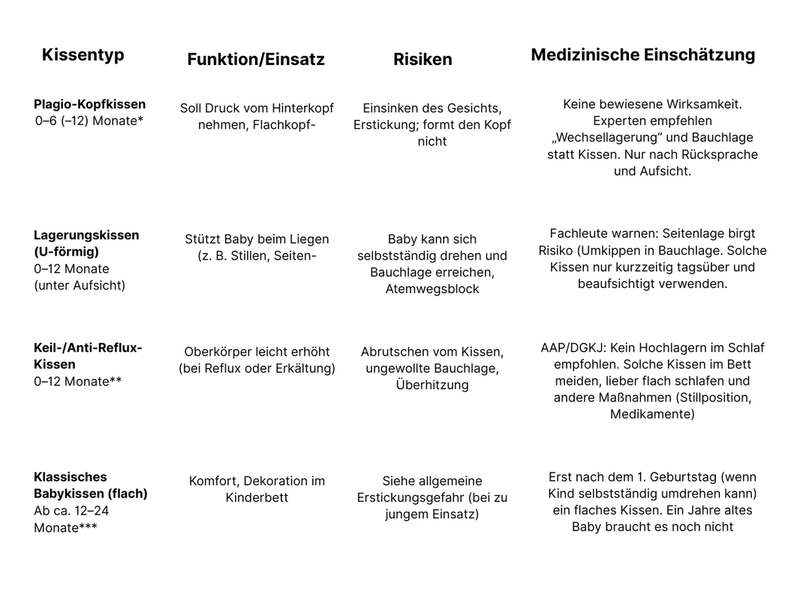
(*) *Only with caution and guidance; especially newborns should generally lie without a sleeping pillow. **This pillow shape (wedge) is only used in exceptional cases, for example during the day under medical guidance.***With a flat, well-ventilated pillow if there is a need for neck support. Sources: Guidelines from AAP, DGKJ, Stiftung Kindergesundheit; specialist literature and safety recommendations.
Conclusion / Checklist
- Keep the sleeping area minimal: In the baby's bed, "less is more." Only back sleeping on a firm mattress, in a sleeping bag rather than a blanket.
- No pillow under 1 year: All experts agree: until 12–24 months, the baby should sleep without a pillow. After that, only very flat and as needed.
- Supervision is mandatory: Positioning pillows (side-lying/positioning or nursing pillows) can only be used when the baby is awake and supervised. They never belong in the bed for sleeping.
- Choose safely: If a pillow is used, it should be flat, firmly padded, and well-ventilated. Pay attention to pollutant-free materials and a wipeable/washable cover.
- Helmet/head constraint if necessary: In cases of severe plagiocephaly, positioning therapy and physiotherapy usually follow; only in a few cases is helmet therapy necessary. The pediatrician decides here.
When in doubt, ask experts: If you have concerns (e.g., flat back of the head, severe reflux), seek medical advice. For healthy baby sleep: "Keep it simple" – avoid pillows and soft bedding to protect your baby from risks


